Resources
Learn more about equitable economics, land value capture, and creating thriving communities
Featured Book
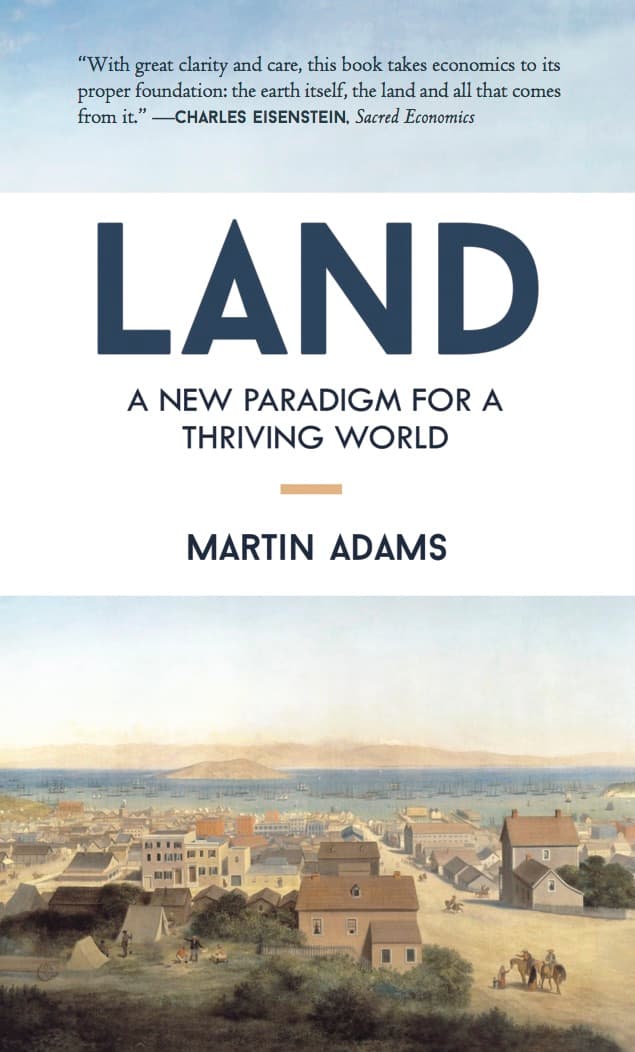
Land: A New Paradigm for a Thriving World
by Martin Adams
What if we lived in a world where everyone had enough? A world where everyone mattered and where people lived in harmony with nature? What if the solution to our economic, social, and ecological problems was right underneath our feet?
"Land: A New Paradigm for a Thriving World" introduces a radically new economic model that promises a sustainable and abundant world for all. This book is for those who dream of a better world for themselves and for future generations.
"A brilliant contribution from one of the most important voices of our time."
— Thom Hartmann, NY Times Bestselling Author
Partner Organizations
School of Economic Science
Educational charity promoting equitable economic principles since 1939. CRA #888707262 RR 0001.
Visit economicscience.ca →Common Wealth Canada
Conducting empirical research on economic rent and its role in society, with a focus on housing affordability and tax policy.
Visit commonwealth.ca →UBI Works
Research and advocacy for guaranteed basic income to alleviate poverty and support vulnerable communities. Over 100K+ supporters nationwide.
Visit ubiworks.ca →Progress.org
Online forum promoting equitable and scientific ideas in economics, society, nature, and technology to affirm a world that works for everyone.
Visit progress.org →Unitism.com
Learn about the philosophy of Unitism and its vision for creating a thriving world where everyone has enough.
Visit unitism.com →Land: A New Paradigm
Read "Land: A New Paradigm for a Thriving World" online for free, or order your copy in print or digital formats.
Visit unitism.com/land →Key Concepts
Tri-Factor Economics
Classical economics recognizes three distinct factors of production: land (nature), labor, and capital. Modern economics often conflates land with capital, obscuring the unique role of natural resources in creating wealth. Understanding this distinction is essential for creating equitable economic systems.
Economic Rent
Economic rent is income derived from exclusive access to natural resources and advantageous locations. Unlike wages (earned by labor) and returns on investment (earned by capital), economic rent is created by the community and nature, not by individual effort. Capturing this for public benefit reduces inequality and funds public services.
Land Value Taxation
Also known as site value taxation, this approach taxes the unimproved value of land rather than buildings and improvements. This encourages productive use of land, discourages speculation, and captures community-created value for public benefit without distorting economic incentives.
Community Land Trusts
Community land trusts separate the ownership of land from the ownership of buildings, ensuring long-term affordability and community control. This model allows individuals to own homes while the community retains land ownership, preventing speculation and gentrification.
Classical Economic Thinkers
Our approach draws on the insights of classical economists who recognized the unique role of land in creating wealth:
Adam Smith (1723-1790)
Author of "The Wealth of Nations", Smith recognized that rent is determined by the productive power of land and increases with the prosperity of society.
David Ricardo (1772-1823)
Ricardo developed the law of rent, showing how landowners capture increasing value as population and commerce grow, without contributing to production.
John Stuart Mill (1806-1873)
Mill advocated for taxing the unearned increment in land values, recognizing that increases in land value are created by society, not by landowners.
Henry George (1839-1897)
Author of "Progress and Poverty", George proposed that land value taxation could eliminate poverty and create broadly shared prosperity without distorting economic incentives.
Want to Learn More?
Contact us to discuss how these principles can be applied in your community or organization.
Get in Touch